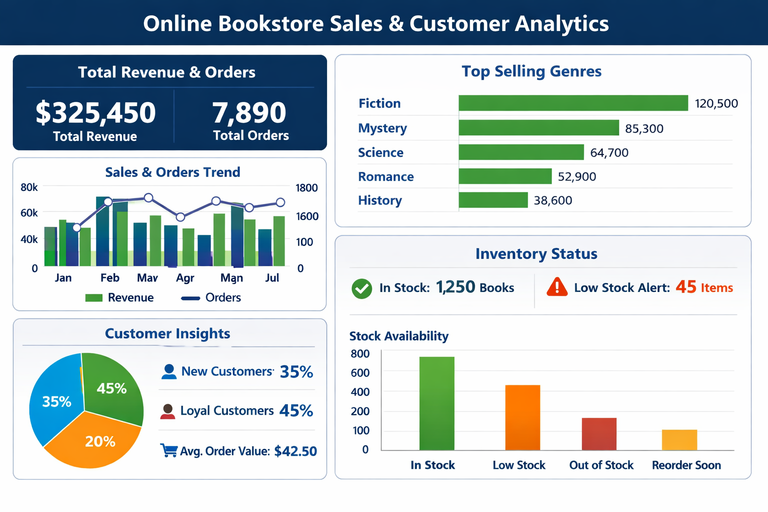
SQL-Driven E-commerce Data Analysis for Online Bookstore
Project Details
Leveraging SQL to analyze bookstore data, uncovering sales insights, customer behavior, and inventory efficiency for improved business decision-making.
Skills
Tools
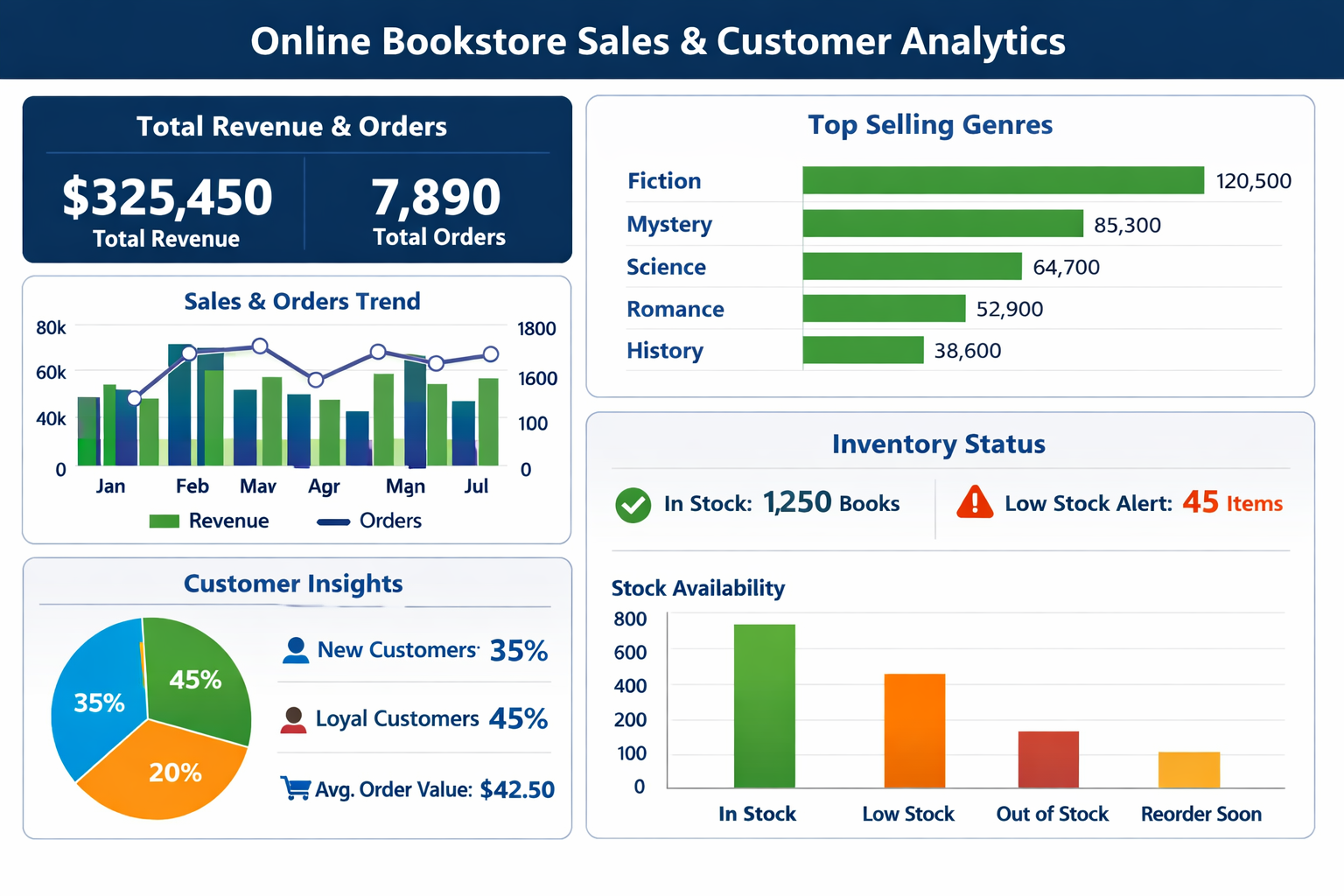
SQL-Driven E-commerce Data Analysis for Online Bookstore
Project Overview
This project involved a comprehensive data analysis of an online bookstore's dataset, utilizing SQL to extract actionable business insights. The dataset, comprising relational tables for books, customers, and orders, provided a rich foundation for structured querying and real-world scenario analysis. My primary role was to dive deep into this data, transforming raw information into strategic intelligence that could drive business growth and enhance customer experience.
The core objective was to illuminate key performance areas, including sales performance, customer purchasing patterns, and inventory management efficiency. By meticulously crafting and optimizing SQL queries, I was able to identify trends, patterns, and anomalies that would otherwise remain hidden within the vast datasets. This process simulated a practical business environment where data is paramount for informed decision-making.
Problem Identification
The online bookstore faced several critical challenges stemming from a lack of deep data understanding:
- Lack of clear visibility into overall sales performance: It was difficult to ascertain which books, genres, or customer segments were driving revenue.
- No structured way to identify top-selling books and genres: This made it challenging to optimize inventory, marketing efforts, and product development.
- Difficulty in understanding customer purchasing behavior: Without detailed analysis, it was hard to personalize offers, predict future purchases, or identify customer churn indicators.
- Absence of insights on high-value vs low-value customers: This prevented targeted marketing campaigns and customer loyalty programs.
- No proper tracking of order trends over time: Seasonal fluctuations, growth patterns, and the impact of marketing initiatives were not clearly understood.
- Inefficient monitoring of inventory and stock levels: This led to the risk of stockouts or overstocking, impacting sales and operational costs.
- Raw and unorganized data: The data, while present, was not synthesized into meaningful insights, making data-driven decision-making difficult.
- No centralized system to generate data-driven business insights: A gap existed in systematically translating data into actionable recommendations.
Goals and Objectives
My primary goals for this project were to address the identified problems by:
- Analyzing bookstore data to extract meaningful business insights.
- Identifying top-selling books and genres based on sales performance.
- Understanding customer behavior and purchasing patterns through segmentation and trend analysis.
- Calculating key performance metrics such as total revenue, order count, and average order value.
- Segmenting customers into high-value and low-value groups to tailor strategies.
- Tracking sales trends over time to facilitate better forecasting and planning.
- Evaluating inventory levels to detect and mitigate low stock or overstock situations.
- Improving overall business decision-making by providing data-driven insights.
- Strengthening my proficiency in advanced SQL concepts, including joins, aggregations, subqueries, and data filtering.
Methodology and Tools
The project heavily relied on MySQL for data manipulation and analysis. The process involved:
- Data Extraction: Writing complex SQL queries to pull relevant data from various tables (e.g., books, customers, orders, genres).
- Data Cleaning and Transformation: Ensuring data accuracy and consistency through SQL-based data cleaning techniques.
- Joins and Aggregations: Utilizing various types of JOINs (INNER, LEFT, RIGHT) to combine data from multiple tables and employing aggregate functions (SUM, AVG, COUNT, MAX, MIN) with GROUP BY clauses to summarize data.
- Subqueries and CTEs: Employing subqueries and Common Table Expressions (CTEs) for more intricate data retrieval and analysis, such as identifying top customers or calculating rolling averages.
- Data Filtering and Sorting: Using WHERE clauses and ORDER BY to isolate specific data points and rank results.
- Insight Generation: Translating the results of SQL queries into understandable business insights, often visualized using Microsoft Excel for reporting and further analysis.
Impact and Outcomes
The successful completion of this project yielded significant impacts:
- Generated clear insights into overall sales performance and revenue trends: This provided a consolidated view of the bookstore's financial health.
- Identified top-selling books and genres: This allowed for strategic decisions regarding inventory stocking, marketing focus, and promotional activities.
- Discovered high-value customers: Enabling the development of targeted retention strategies and personalized marketing campaigns to foster loyalty.
- Improved understanding of customer purchasing behavior and patterns: This informed product recommendations, cross-selling opportunities, and overall customer engagement strategies.
- Enabled tracking of order trends over time: Facilitating more accurate demand forecasting, inventory planning, and resource allocation.
- Highlighted inventory gaps: Proactively addressing potential stockouts and overstocking scenarios, leading to optimized inventory management and reduced costs.
- Transformed raw data into actionable insights: Directly supporting data-driven decision-making across various business functions.
- Demonstrated the power of SQL for solving real-world business problems: Showcasing practical application of database querying skills in a commercial context.
- Strengthened analytical thinking and ability to derive insights from data: Enhancing my capacity to provide strategic value through data interpretation.
This project not only refined my technical SQL skills but also solidified my ability to act as a data-driven strategic partner, translating complex data into clear, impactful business recommendations.
Next Project
